Thursday, May 22, 2008

Pans Labyrinth


What follows is something I developed for a Plumbline radio broadcast:

Christian Imagination:  Reclaiming Perspective

Pans Labyrinth, the 2006 film by Mexican director Geuirmo Del Torro, tells the story of a young girl named Ofelia who travels with her mother to live at a military outpost with her new step father, a captain in Franco’s military shortly after the Spanish Civil war.  There she discovers a garden labyrinth which leads to a strange, and magical world, in which she encounters a faun.  Believing Ofelia to be a long lost princess, the faun gives her three tasks to perform so she might prove her identity.  The film moves between Ofelia’s struggle to survive the oppressive life with her step father, and her quest to complete the three tasks to prove her identity. Eventually we discover the two stories are actually one ... the magical world of the Labyrinth is Ofelia’s other worldly perspective of her struggle to survive the harsh reality of living with her step father. 

Pans Labyrinth is an excellent film.  The story is moving, the cinematography is beautiful - the film is well done.  But is it Christian?  That depends.  Some Christians think films should pass both a moralistic and evangelistic litmus test.  Films with no sex, violence, or profanity, which include a wholesome, usually Christian, message, are deemed acceptable.  Using this criteria, Pans Labyrinth probably wouldn’t make the cut - too much violence, and there is nothing explicitly Christian about it.  But should this be all we look for?

While the Christian community should be concerned with morality, rejecting films that glorify violence, gratuitous sex, and vulgarity for it’s own sake, we should also judge films by other criteria.  A good film has a story to tell, creating a space for the audience to wrestle with important themes and ideas.  A good film is one that creatively and imaginatively invites us into other worlds, into the experiences others.  This is not escapism, but an opportunity to see reality from a different perspective.  Here we discover the significance of artistic expression - to frame the world in such a way we are able to rediscover vitality and meaning in the ordinary aspects of human life.

The Christian community needs good films.  At the very core of Christianity we find a narrative -  creative accounts of real people and events which reveal God’s redemptive acts in history.  The gospels are inspired accounts of God’s saving work in the person of Jesus Christ... detailing the miracles, the teachings, the confrontations with rulers and religious leaders, acts of love and compassion, all climaxing with Christ’s death and resurrection.  The Acts of the Apostles and the Epistles reveal the bursting forth of the kingdom of God through the proclamation of the gospel, and the pouring out of the Holy Spirit.  Through His written Word God speaks to us ... creatively, and imaginatively, beckoning us to see the world through the lens of Christ’s death and resurrection.  

Sadly, it seems the imagination of the Christian community has become dull.  How often we approach scripture as if we’ve heard it all already, as if it has nothing to say to us.  How often we approach the Bible as a deposit of abstract rules and principles, that if followed, programatically lead to a better life.  We must reclaim our imaginations.  We need the arts - film, music, poetry - to stretch us, to stoke the flames of creativity, so we might learn to see differently.  We must approach scripture with our imaginations fully engaged, so that through the redemptive story we might experience the risen Christ, and have our eyes opened to the presence of his kingdom.  

  In the book of Revelation, John addresses the issues facing the churches of Asia Minor.  He gives them a glimpse of the divine perspective, pulling back the curtain to reveal that emperors and kingdoms are really beasts and harlots in allegiance with the dragon at war with God and his people.  While the world sees Christ’s death, and the suffering of the church, as weakness, John reveals that from the throne room of God, this suffering proclaims the power and victory of God over the beasts and dragon.  In the final chapters, John imaginatively describes creation as seen from the perspective of Christ’s resurrection; a new heavens and new earth, a new order of peace and justice, the dwelling place of God and the Lamb.  In the same way, Pans Labyrinth offers a similar perspective - a young girl understands her horrible circumstances as an unfolding fairy tale, as she sacrificially fights evil monsters in order to save her baby brother.  We need films like Pans Labyrinth to stretch our imaginations, to help us remember there is more to the world then meets the eye.  That if we truly believe the gospel there is no place for fatalism... because there is more to the story.  As Christians we need the arts...we need theater, music, and poetry.  We need good movies, because we need to hear stories that remind us to look at the world differently.  Stories that point us back to the Biblical story, which calls us to see the world not as it is...but as it is and will be because of the death and resurrection of Jesus Christ.


Sunday, May 18, 2008

For the love of old people...


This morning I preached at the CRC church in Sanborn, Iowa - a small farming community in northwest Iowa.  It's a small church trying to recover from a split a few years back.  I would say the pews were about half full.  The church is an older congregation, but there is a growing number of young people and families... this morning the youth led most of the service.  Overall, it went very well.  

I have to admit I love preaching in these types of churches.  Good, honest, hard working people... no frills, no nonsense...  They want to hear the word preached - and then go eat some good food with family and friends.  They support Christian schools, and mission trips to other parts of the world.  They have pictures of missionaries on their walls... and support them with both prayers and offerings.  Many of them show up faithfully every Sunday - twice.  They love God, are generous with others, and try to live faithful lives.

I'm ok with that.  At a time when so many believe that Christian spirituality must be accompanied by radical manifestations of signs and wonders, it's refreshing to run across good old fashioned faithfulness.  In a recent conversation some college students expressed the belief that if you don't feel like going to church, you are just being a hypocrite by going.  Faith needs to be felt... experienced... there needs to be radical signs of transformation, and the power of the Spirit at work in your life if you claim to follow Christ.  I get that too... But the church can learn many things from the veterans, the more experienced Christians, among us... such as duty.  There are many days we don't feel like doing what needs to be done.  There are many Sunday's (more then I would like to admit) when I don't feel like going to church.  I sit in the pew thinking about the confrontation with my 4 year old son regarding his morning attire... or reflect upon the stressful events of the past week.  But does that mean I shouldn't go?  I am being a hypocrite?  Nope... I don't think so.

There are many things in life we do because they need to be done.  Loving someone like your wife or child doesn't mean you always "feel it".  Love in this instance is something you do... you work at...  Is it hypocricy to change a kids diaper when you don't feel like it?  Is it hypocritical to tell your wife you love her even if your irritated as ...never mind.  Of course not!  So why do we assume that our relationship with God will be any different?  There are things we do because we are supposed to... it's what you do when you are in a relationship.

Now, I understand there needs to be times when you do feel it... when you are overwhelmed with love and gratitude.  Often these experiences come upon us in the ordinary moments - they cannot be manipulated or manufactured.  They tend to flow out of duty  - when we are faithfully doing what we are supposed to.

I'm all for different forms of worship... I realize we are all unique, and often these differences manifest themselves in our styles of worship.  Great... it's a part of being human.  Let's just lay off the old people... 

Friday, May 9, 2008

Graduation


Today was graduation.  300 and some former students ready to get on with it, all sitting on the stage, waiting...  They are waiting for their names to be read, to walk across the stage, grab with the left and shake with the right.  They are thinking intently about every step...self conscious about every move.  Trying not to smile...but then completely failing to hold it in.  One girl grabbed her diploma, shook hands, smiled... and then gave the "rock on" sign... complete with protruding tongue.  You know... the index finger and pinkie hook'em horns.  The ones that just can't remain still as a palm muted, grungy E5 chord continuously plays with a 4/4 back beat.  Though she was eyeing her family siting behind me, it seemed as though she was looking at me... and if I would have had a lighter under my academic attire I surely would have raised it in salute.


The service was nice... the speaker was wonderful.  She spoke about the importance of names...of naming things rightly.  Calling things what they are - identity.  A wonderful send off for a group of young people ready to take on the world.  The whole thing set me off thinking about this and that.  About the beauty of the different stages of life.  The youthful optimism and hope embodied by this group of impatient 20 somethings just ready to get on with it already.  I thought about my kids... and the emotions I will feel when, God willing, I hear my daughter Naomi's name read, and I see her walk proudly across the stage.  I wondered how long my son's hair will be under his graduation cap...and what my daughter Savannah might have with her to remember her twin sister.  Hope... freedom... possibility... these are the emotions I felt this morning watching the students do their thing.


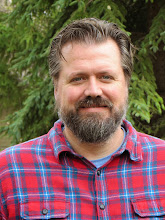
And I was also glad to be where I was sitting.  Middle aged, with a wife and kids... and an out of control beard that is getting more grey by the day.  Life is good.  Don't get me wrong, it's tough from time to time.  But that's a part of it - it's what makes life "life".  
I won't forget the girl who gave the "devil horns" sign.  In the midst of a service full of pomp and circumstance... there were little windows of life.  Rock on young lady... and may your life be as full and complete as a Led Zepplin classic blaring over the car stereo on a warm summer evening.

Sunday, April 20, 2008

WWLS...What Would Luther Say?


I have a deep respect for the Roman Catholic Church.  For 6 years I was a part of the Newman Catholic school system in Mason City, Iowa.  I wasn't Catholic, but I have this strange suspicion the priest and nuns were brainwashing me.  To this day I have this urge to say "and also with you"... or "thanks be to God"... (Which thankfully we say at the Christian Reformed church I attend)

A few days ago I watched the news coverage of Pope Benedict's visit to the White House, and I had a "this is why I am a protestant" moment.  I have a deep respect for Pope Benedict, but I had a difficult time stomaching the pomp and circumstance.  There was the Pope, next to President Bush, watching a military parade being put on in his honor.  The glitz, the glamour, the power and prestige, the "papal protocol" (which Mrs. Bush apparently broke by wearing white...)...  And all I could think was:  What would Martin Luther say?  Then I chuckled... That's why I love Luther...

The contrast was too much.  Here was the head of the Catholic church, the "representative of Jesus Christ on earth" as one reporter put it, at the center of a media circus.  And yet, the one he represents had an entirely different experience.  Instead of power and glamour, he experienced shame and forsakeness.  Instead of presidents and prime ministers, he associated with fishermen and prostitutes - the sick, the lame, the suffering.  Instead of Papal protocol, he had no place to lay his head...  The essence of Biblical Christianity is  the Lamb who has been slain, and the testimony of the martyrs proclaiming the gospel through their suffering.  A confrontation with the powers of this age... not a part of the program.  Sadly, it seems, too often both protestants and Catholics want to be part of the show.

What would Luther say?  I think we know...

Thursday, April 17, 2008

Slaying Dragons


So I teach this class - New Testament studies - covering both Acts and Revelation. Although it may seem a weird combo, the deeper you go the more it makes sense. (At least for me ... not sure for my students...) This post is based upon our class discussion today...

Today we had a good discussion ( at least I thought it was good...) about the purpose of Revelation, and what it means to live prophetically. As the discussion progressed we realized there needed to be a clarification of terms - specifically what we mean by "prophetic". How is John's apocalyptic vision prophetic? And how is he calling the church in the first century to live prophetic lives in the face of Roman power and persecution?
Certainly, John is giving first century Christians a word of hope in a time of immense suffering... but he is doing much more. He is calling them to a way of life. He is calling them to be washed in the blood of the lamb, which, at least in the context of Revelation, isn't about being saved from personal sins, it's about a life of faithfulness and discipleship. To follow the lamb who has been slain, taking our place in the struggle against the beasts and dragons, parallels the call of the gospels to take up our cross and follow Jesus. It's more then just an intellectual ascent, a belief or a hope, it's a call to a different way of life.

So what does this way of life look like? And how is it prophetic? An all encompassing biblical definition of "prophetic", from my perspective, it this: to proclaim the Word of God through speech and action. In Jesus Christ, God has spoken... he has revealed Himself, and he has revealed who we are. In Jesus Christ, we know who God is, and we know what it means to be human for in him we find both divinity and all created reality (Chalcedonian definition). Therefore the call to follow Jesus is the call to become who God wants us to be. Through faith we are united to Christ - his death and resurrection - discovering who we were created to be.
In Revelation 17 and 18 John calls first century Christians out of "Babylon"...out from the "beasts and dragons". He calls them out from the powers that dehumanize and destroy... from the powers that symbolize the inward turn... the glorification of the self, the essence of idolatry. In the same way, John calls Christians of the 21st century out from the powers of this world...powers that dehumanize, control, and destroy. He calls us out of idolatry... out of self glorification... self worship... and into the worship of the true God and the Lamb. Through this prophetic word, I would argue we are being called to be truly what we were created to be...human. In a world obsessed with power, with wealth, with status... we are being called back to a human life, an "ordinary life". A life of love, simplicity, generosity, and sacrifice... a life of giving ourselves for the other... pouring ourselves out in love, even for those who would hate and destroy us.
With regard to Revelation we must remember the imagery John uses to communicate his message. How does John speak of the death and suffering of Christ? What does the "weakness" of the cross look like from the perspective of the throne? Victory... power... the Son of man coming on the clouds. What does the "ordinary" life, the human life, we are called to in Christ look like from the throne? The faithfulness of the little old lady in the back pew, pouring herself out in prayer, in service, in the love and embrace of those she ministers too, what does this look like? A dragon slayer - the great multitude that no one can count... singing the song of Moses, to the One who sits on the throne, and to the Lamb. This is a life lived in the Spirit.

This is not first and foremost a call out of complacency, it is a call to faithfulness, a call to discipleship. This is a call to live as the Christian community, in allegiance to the risen Lord, in opposition to the powers of this world. This is call to proclaim the presence and reality of the Kingdom of God to the world, reminding them of who they are, and what the world is becoming, and ultimately will be, at the second coming of Christ: "The Kingdom of the world has become the kingdom of our Lord and of his Christ, and he will reign for ever and ever." (Revelation 11:15)

Sunday, March 30, 2008

Cable is Evil


The other night there was a meeting.  A revival meeting of sorts...to cast out a demon from our college campus.  Cable Television.  I wouldn't have been involved if I hadn't been asked to speak.  I think I was supposed to talk about the evils of cable TV...but ended up re-telling an episode of the Simpsons - you know, the one where Marge helps get Itchy and Scratchy taken off the air...

The thrust of the meeting consisted of arguments concerning the "problem" of cable "addiction".   A part of me was a little uncomfortable with the way the word "addiction" was thrown around.  Should we start a support group?  Is there a 12 step program?  I'm not denying the power and allure of the "idiot box"...but just turn the thing off, for Pete's sake!
Just for the record, I originally supported the motion to get rid of cable - but not because I think cable is evil.  The so called cable problem is a symptom of a deeper issue:  What is the purpose of college education?  More and more it seems we are running a hotel / resort - a very expensive hotel / resort.  Academics just seem to get in the way of the more important things going on.  Oh, yeah, I shouldn't use the word "academics" - it wreaks of intellectualism.  I guess I can't use the word "scholar" either...when suggested that a student's role for four years is that of scholar - eyes roll.  We are America, after all, a democracy...and what's more democratic then cable TV.  On cable TV all ideas are equal...and the TV watcher has the ultimate power of veto - the channel changer.  There is nothing more un-American as the notion of "academics" or "scholar".  Such language reflects a "youthinkyourbetterthenmeism".  And we certainly can't have that.
 
I realize that getting rid of cable is not the cure all.  There are many other avenues of distraction, some even more influential then cable TV.  Such distractions are not always a bad ... we need them from time to time to get some perspective, or just be entertained.   But when I hear of students  threatening to transfer if cable TV is taken away?  Hmmmm...I have to wonder.... 
 

Thursday, March 20, 2008

Horton hears the gospel?


A few weeks ago I took my kids to see Horton Hears a Who.  For the last year or so I have been reading the book to my kids.  They like it because it rhymes and has silly words...and I think they find the story interesting.  The film was very good...the best kid's movie we've seen in quite awhile.  My kids snoozed through Ratatouille...really, do 3-5 year olds really care about French chefs, or rats who can cook?  The Veggie Tales "The Pirates who don't do anything" lived up to it's title.  Horribly bad.  Come on...mutant cheese curls?  To quote Southpark..."dumb dumb dumb dumb dumb".  So we were excited to finally see Horton, and it lived up to our expectations.  My kids loved it.

I have to admit there is something about the Horton story that intrigues me as a theology guy.  I'll never forget watching the old video version of Horton...it came on our VHS copy of The Grinch.  I hadn't read the book in awhile, so I had forgotten the story.  As I watched the video with my kids it struck me...we were watching the gospel.  Not in an allegorical sense, but in a thematic sense.  There was this world...floating along on a dust speck.  Most of the inhabitants oblivious to the fact there existed anything outside their world...oblivious to the fact they were being watched over by a huge elephant.  But watch over them this elephant did.  He cared for them, had compassion on them, fought for them, and  searched for them.  Too me, the search is the most powerful part of the story.  Vlad Valdikoff dropping the clover into a field full of clovers...and Horton endlessly searching, one by one, until the 3 millionth flower...he finds them.  

One of the images I try to impress upon students who take Theology 101 is the image of God, in the Garden of Eden, calling out for Adam.  Genesis 3:9 "But the Lord God called to the man 'Where are you?'"  The biblical story reveals a God who endlessly and tirelessly searches for his creation...a search ultimately fulfilled in the person of Jesus Christ.  A God who was willing to be caged, and beaten...all for the sake of his people, for the sake of humanity.  "Forgive them, for they know not what they do."  A world, saved by the smallest and weakest of all...saved by a child. 

I know, I know...why ruin a nice story with all this theologizing.  Fine...experience the story for what it is...a wonderful story, that just so happens to parallel the biblical story in so many ways.  Coincidence?  I didn't think we believed in coincidences....?