Wednesday, October 29, 2008

The Glory of God...


I hear it all the time.  "For the Glory of God".  "For God's Glory".  Over and over again... yet no one ever defines what they mean.  It's a catch phrase... Christian lingo.  If you want to sound pious... theological... orthodox... end what your saying with "For the Glory of God".  

The other day a presenter put a quote up on the power point screen - a quote by Descartes - something to the effect of the end of science is the health of people.  Of course, the quote was quickly dissected and deemed lacking in truth.  After all the end of science is the "glory of God" not the health of people.  I interjected.  My point?  What if the health of people is the glory of God?  What if loving our neighbor as our self is loving God with all of our heart, soul, mind...?  Didn't Jesus say what you do to the least of these you do unto me?

Don't get me wrong - I believe in the glory of God.  I just think that God loves what he has made.  That in Jesus Christ God has demonstrated his glory by moving out of himself to be for the other - to be for his people - to be for his creation.  God is glorified by rocks being rocks... and cows being cows... humans being humans.  Therefore, when we use our God given ability to make sick people well... when we use science and technology to help people be people we are glorifying God.  After all - God wants us to be human and Jesus died on the cross to prove it.

Maybe I'm a bit weary of all the grandeur... the lofty theological definitions that make God into the big narcissist in the sky.  All of our definitions, terms, propositions, and doctrinal statements are blown up by the scandal of the manger and the cross.  God loves us - he loves all of creation - and he wants us to be what we have been created to be. He wants our humanity. Glory be... 


Friday, October 24, 2008

Pacific Northwest


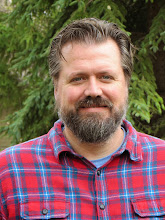
I knew I would love it... Obvious I would love it. Lately I've been looking like a lumberjack. I would say it's a "projection of my digital self" but it's not digital. I have this big beard... and long hair. So I fit right in at the local cafe with a view of the Pacific... eating Clam Chowder and a Roast Beef sandwich.


I'm in Lynden, Washington for the weekend - Jim Schaap's hired thug. (Actually I think he wanted me to come along so I could drive through Seattle.) This morning I spoke in chapel at Lynden Christian... (I had to follow a representative of the Seattle Seahawks giving away jersey's... you can imagine... Seahawks or some college prof coming to "blah blah blah".) But it went well. Then I had free time. Schaap is the rock star... he's the one who has to do the hard work. I just get to drive a rental (new, black, ford mustang) up and down the coast - eating, drinking, and talking with locals. Funny when they find out I'm from Iowa... they are surprised... I'm not sure why.


Northern Minnesota with mountains... that's how I describe northwest Washington state. Wonderful... I'm tempted to have my wife and kids fly out - and stay for awhile. The colors, the smells, the gray clouds and cold damp air. My idea of the new creation... only with a little more snow. Hey, I'm from Minnesota... what would you expect?

Tuesday, October 21, 2008

What this says about me...


My wife and I have become Soprano freaks. Because we didn't have cable (or HBO) we didn't have the opportunity to watch the show when it was originally aired. So we decided to start watching it through netflix - and both of us are hooked. We are up to season three... the episode we just watched the other night was fascinating.

Tony's therapist is brutally attacked in the parking garage. The attacker is caught - but because of a technicality he has to be be released. A moral dilemma ensues... should she tell Tony about the attack - knowing full well the attacker will end up "sleeping with the fishes"? Or should she trust in the social contract... civilization. I found myself through the entire episode longing to hear her tell Tony... to put into motion what is after all - justice. The episode ends with Tony asking her... "Do you have something to tell me?" "No." She responds - and the credits roll.

What does it say about me that I was disappointed? I couldn't quit thinking about it... just say "yes". Tell him... Part of the episode, I think anyway, struggles with this question: Do we need the Tony Soprano's of this world? Do we feel a sense of security because they are there... those who are willing to do the dirty work? Reminds me of Jack Nicholson's character in the film A Few Good Men: "You want me on that wall... you need me on that wall..."

And yet I profess to follow the crucified Christ... the one who tells those who follow him to "turn the other cheek" and to "take up our cross and follow". So what does it say about me that I find myself drawn to the Tony Soprano character? I'm not really sure...

Wednesday, October 15, 2008

Escahtological Inbreaking of Time


Last night in the worship class I teach we discussed the significance of "God's time". It was very difficult to have this conversation without sounding like a dualist (a 4-letter word at Dordt college... I was waiting for the "dualism" police to break down my door...) We talked about heavenly time, divine time, and our time, all in the context of our visit to the Catholic church. Father Klein walked us through the Catholic mass, commenting and explaining, when he said something about the relationship between the book of Revelation and Roman Catholic liturgy. During the hour worshippers engage the liturgy - they are no longer solely experiencing temporal time... but they are mystically immersed in divine time. In this context worship becomes truly "catholic". The boundaries of minutes, hours, and years are shattered as the martyrs, the faithful - all of creation past and present- worships the one who sits on the throne and the lamb.
In class I referred to this as the eschatological inbreaking of divine time. The cycle of weekly worship. The liturgical year. Praying the hours. All glimmers of this eschatological inbreaking.


Wednesday I came home from a meeting and I could feel it in my knees. I was in trouble. Whenever I get sick I feel it in my knees first. I laid down "just for awhile"... and I was out for the count. Chills, aches...sleep. And sleep I did. I really hate being sick. Classes to teach, papers to grade, sermons to write... all of it comes to a screeching halt. The eery movement in and out of true consciousness - attempting to get up only to be sucker punched in the stomach. Down again.


I couldn't help but reflect upon the conversation from class... the eschatological inbreaking of divine time. Our culture is obsessed with time management. We break time into nanoseconds so we can squeeze out every ounce of productivity. Even at a college - which is supposed to be a place of reflection - our protestant utilitarianism merges with our capitalist tendencies and we cram as much stuff as we can into every ounce of time. Students and faculty alike...moving at warp speed. So maybe we should be thankful for colds...for those minor bouts of sickness that throw wrenches into the gears of our managed time - forcing us to stop whether we like it or not. Getting clubbed over the head with the eschatological time of God. Just a thought...

Tuesday, September 16, 2008

Chaos Theory


One of the books I have students read in Foundations of Worship is by Harold Best - Unceasing Worship.  In the chapters for tonight's class he claims the God of the Bible is not just a God of order... but a God of chaos.  God is an abstract artist... creating out of nothing.  No where in creation do we find a perfect circle or straight line.  No where in creation do we find a complete replica of a tree or a blade of grass.  Each is different... predictable yet unpredictable.  Similar but not the same.  The God of the Bible is a God who cannot be figured out or fully anticipated.  While he is faithful... he also surprises us.  While he is the "same yesterday today and forever"... we dare not box Him in.  Did Elijah expect to experience God in the silence?  Did orthodox Jews expect to experience God in a wandering rabbi?

Which has me thinking more and more about so called "orthodoxy".  Now please don't get me wrong... I believe in truth... that God has revealed Himself.  Yet... when does doctrine and right belief trump the Spirit of God that moves untamed like the wind?  When does order and structure become the idolatry of the status quo?  When does law become rigid and unforgiving... when does orthodoxy become judgmental and graceless?

I'm not advocating we embrace total chaos or relativity.  I'm advocating a movement to the middle... a paradoxical tension that doesn't have a nice tidy resolution.  While we must proclaim the truth about God as revealed in the testimony of scripture... we must also proclaim the good news of grace and forgiveness  - God bursting into our lives in unpredictable ways.

Tuesday, September 9, 2008

A Risk Worth Taking


One of the courses I teach is called Gen 300.  Last week I got up on my box... I sermonized... passionately describing the God of the Bible as a God who can't help but create.  A God who exists in community - Father, Son, and Holy Spirt.  When John says that "God is Love" I believe he is saying that God exists as this trinitarian community.  Thus... creation is the outworking - the outpouring - of this love.  

But love is a risk... creating is risky.  Bringing forth life with the capacity for love is to bring forth beings with the capacity to say "no".  Parents understand this very well.  Thus... the God of the Bible took a risk - a risk he deemed worth taking.

Not everyone appreciated my perspective.  How can God risk?  Is not God omniscient?  Doesn't he know what will happen before it happens?  Excellent questions...  but they are questions that originate outside the biblical story.  We all do it... start with a philosophical proposition concerning such things as "omnipotence" and "omniscience" and read them back into the text.  But what happens if we let the text speak?  Where does the Biblical story lead?

Lately in my other classes I have been emphasizing reading the Bible as narrative.  Allowing the Biblical story to inform our doctrine.  Easier said then done... I realize.  I believe when we approach the Bible this way God speaks to us... he pulls us into the Trinitarian life... allowing us to see what he has made from his perspective.  Allowing us to experience the suffering of the cross for what it is... God's desperate search for Adam... for us.  God's willingness to enter hell itself - God forsakenness - for the sake of a people and creation he loves.  

The truth as I see it:  The biblical story proclaims the good news of a God who searches... the story of how the Divine "yes" overcomes our rebellious "no".  A God who is for His creation...

Good news indeed.

Sunday, August 31, 2008

Superheroes, Fantasy, and the Christian Imagination


When I was young my mother would take me along to the grocery store.  She would make her way through the aisles and I would sit by the magazine rack reading comic books.  Spiderman, Superman, X-men… until finally it was time to go.  I grew up immersed in superhero mythology.  I would tie bath towels around my neck, jump off picnic tables and fly around the yard, doing battle with imaginary bad guys.  Now as a college professor, I’m supposed to be into more academic and scholarly things.  Yet when the new Batman film, The Dark Knight, came out – I couldn’t help myself.  I had to see it on the big screen.  So a friend and I went – and we were not disappointed.

There has been much interest lately in the fantasy realm.  Lord of the Rings, Harry Potter, Spiderman and now Batman.  They represent a mythical world – an alternate reality where magic and super powers are possible.  Lately, millions of people, especially young people, have been drawn in.  What are we to make of this?  Some see these stories as a form of escape; people projecting themselves into the more interesting and heroic lives of Harry Potter, Frodo, or the masked Bruce Wayne.  Some see them as childish nonsense…a way to relive childhood fantasies.  Others admittedly just don’t get it… nor do they want to.

Such perspectives fail to address the purpose and function of all narrative – to help us make sense of the world.  We read or watch films to be drawn in to a story… not for the purpose of escaping our lives, but so we might makes sense of the world we inhabit.  Walter Wangerin Jr, in his book The Orphean Passages, writes:  

In order to comprehend the experience one is living in, he must, by imagination and intellect, be lifted out of it.  He must be given to see it whole; but since he can never wholly gaze upon his own life while he lives it, he gazes upon the life that, in symbol, comprehends his own…  Myth is just a symbol…And when the one who gazes upon that myth, suddenly, in dreadful recognition, cries out, ‘There I am!  That’s me!’ Then the marvelous translation has occurred: he is lifted out of himself to see himself wholly.

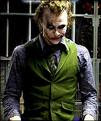
A primary theme of The Dark Knight is the manifestation of evil that is the Joker.  There is no explaining the Joker.  Even when you think you have some insight into the reason for his evil ways, you discover he is just playing with you.  He is evil.  He has no overarching plan; no grand scheme.  He is not after power or money, his only purpose is to unleash chaos.  How does one defeat this type of evil?  How can Batman, a symbol of morality, of truth, of law and order, overcome him without becoming part of the chaos…without compromising?  How does he defeat terrorism without becoming a terrorist?  As we contemplate the chaos in our own world – economically, politically, culturally – as we think about 9/11 and the wars in Iraq and Afghanistan - how do we answer this question?

The biblical story tells about the unleashing of chaos in the world.  From Eden, the flood, and Babel; through Egypt, Babylon, and Rome… the bible reveals there are principalities and powers at work in this world.  They are at work in us – unleashing a chaotic, Joker like, violence.  Often we take up arms against this chaos by voting for the right political party, by enacting laws, or erecting fences to keep “others” out.  Or we put our trust in power – dealing with the threat of death by inflicting death.  Yet, in the end none of these methods work.  As Christians we follow a crucified Christ, one who stood face to face with chaos - with the Joker’s of this world - and died.  Willingly giving himself, hanging on the cross, taking the full brunt of the demonic onslaught without resistance.  He calls us to do the same.  We are called to become peacemakers - to not resist an evil person - to love our enemies and pray for those who persecute us.  We are called to take up our cross, taking the chaos upon ourselves, so we might be awakened to a new reality firmly rooted in Christ’s resurrection.

While each Sunday Christians celebrate the presence of Christ’s kingdom, the world in which we live more often resembles the world of the Joker.  How often Christians succumb to his maddening taunt “Come on… hit me!” finding ourselves caught in an endless violent cycle which the Joker wins every time.  How do we see the Kingdom of God amidst this chaos, violence, and hatred?  Through transformed and engaged imaginations.  With imagination we make sense of our experiences, piecing them together to discover meaning and purpose.  With our imagination, shaped by the biblical story, we are able to see beyond the way things appear to the reality of the way things are and will be.  

Here we discover the importance of films like the Dark Knight or stories like Harry Potter.  At a time when distorted views of science, technology, and capitalism have deadened our imaginations, fostering a fatalistic understanding of the world, these stories sharpen our imaginations by providing an alternate picture of reality.  We enter into the world of hobbits and superheroes, not to stay there - not because they are worlds we can inhabit.  We enter them to learn about the world in which we live… to see this world “rightly”.  Going, as Bilbo Baggins puts it, “there and back again”.

Does this mean that all Christians have to like these types of stories? - Of course not.  But as Christians, we must exercise our imaginations.  We need to be reminded, whether through caped crusaders, the cooing of a new born baby, or the rising of the sun… that this world is a magical place.  There are forces of chaos still present in the world, but God sits on the Throne and he makes all things new through the blood of the lamb.  We come to experience this newness through Spirit bathed imaginations which remove the scales from our eyes, allowing us to see the miraculous and magical presence of Christ’s kingdom.